hands, dirty
a humble practice in facing disappointment
Backdrop
Two weeks ago, Sunday July 20th. I playtested a participatory performance piece in The Garage. Ramzy, Janice, Tiffany, Dara, Alexandros, and Queenie all helped me try out my idea for Project 1. It didn't go the way I wanted.
I knew the project was, objectively, good enough for the purposes of our assigned exploration. I had done the vast majority of the work. There were more than enough photos and videos of the process. It was time to document. But sitting down to capture and share the work, the way I'm trying to do here now, felt impossible then. I distracted myself with other work. I didn't deliver. I didn't present.
That Friday, I spoke with Sarah about my struggles with schoolwork. At the time, it wasn't clear to me that my challenge was to overcome shame. I believed myself frustrated with a lack of ability to materialize my artistic vision. She invited me to explore what I was feeling through my art practice. Immediately, I started ideating.
Ideating from Emotion
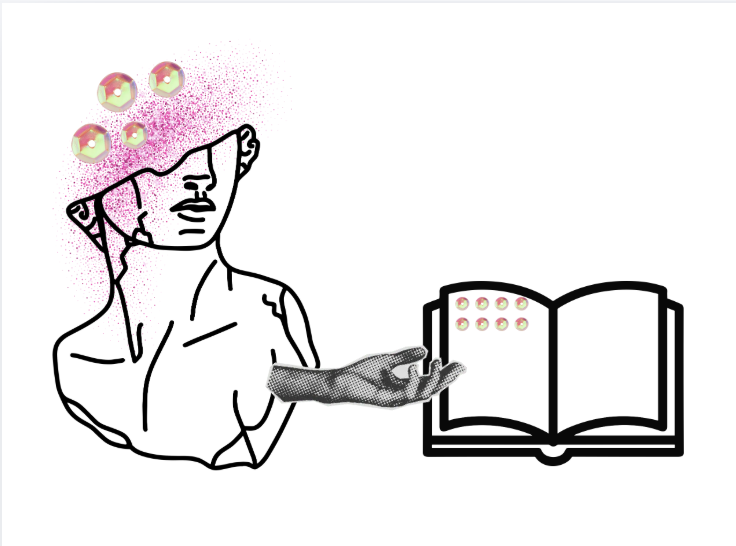
I wanted to capture what it felt like to be incapable of organizing the kaleidoscopic thoughts that make up the ideas in my mind. I envisioned a head full of glitter and a notebook. The invitation is for the audience to help me (the head) by placing my thoughts (the glitter) in order on the notebook; an impossibly frustrating task.
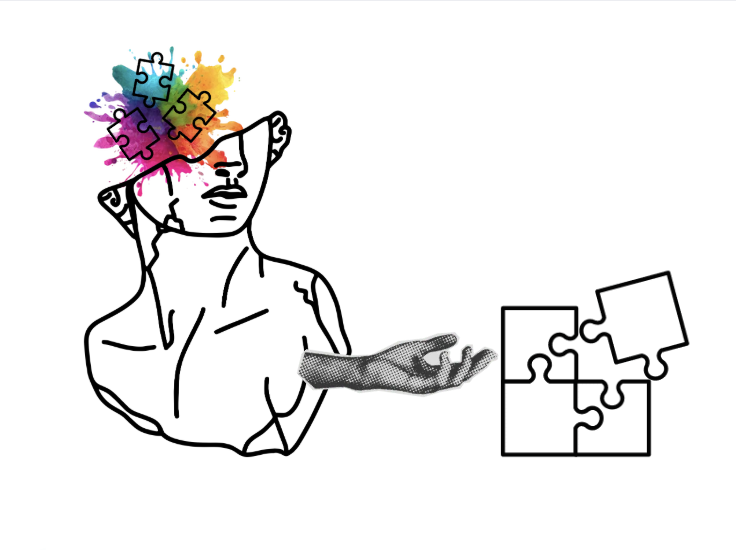
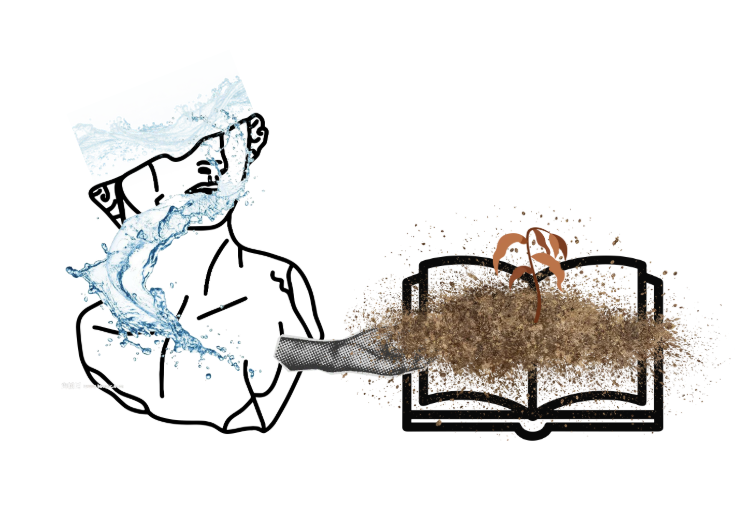
The idea went through a number of iterations while I workshopped it with friends and family. In one version, the glitter became interactive puzzle pieces (which would help me combine projects with interface labs). In another, I would remove the interaction and make the head overflow with water that never reached a notebook full of dry dirt and dead plants. This version of the idea – abundance, just out of reach – eventually lead to the current iteration of the work.
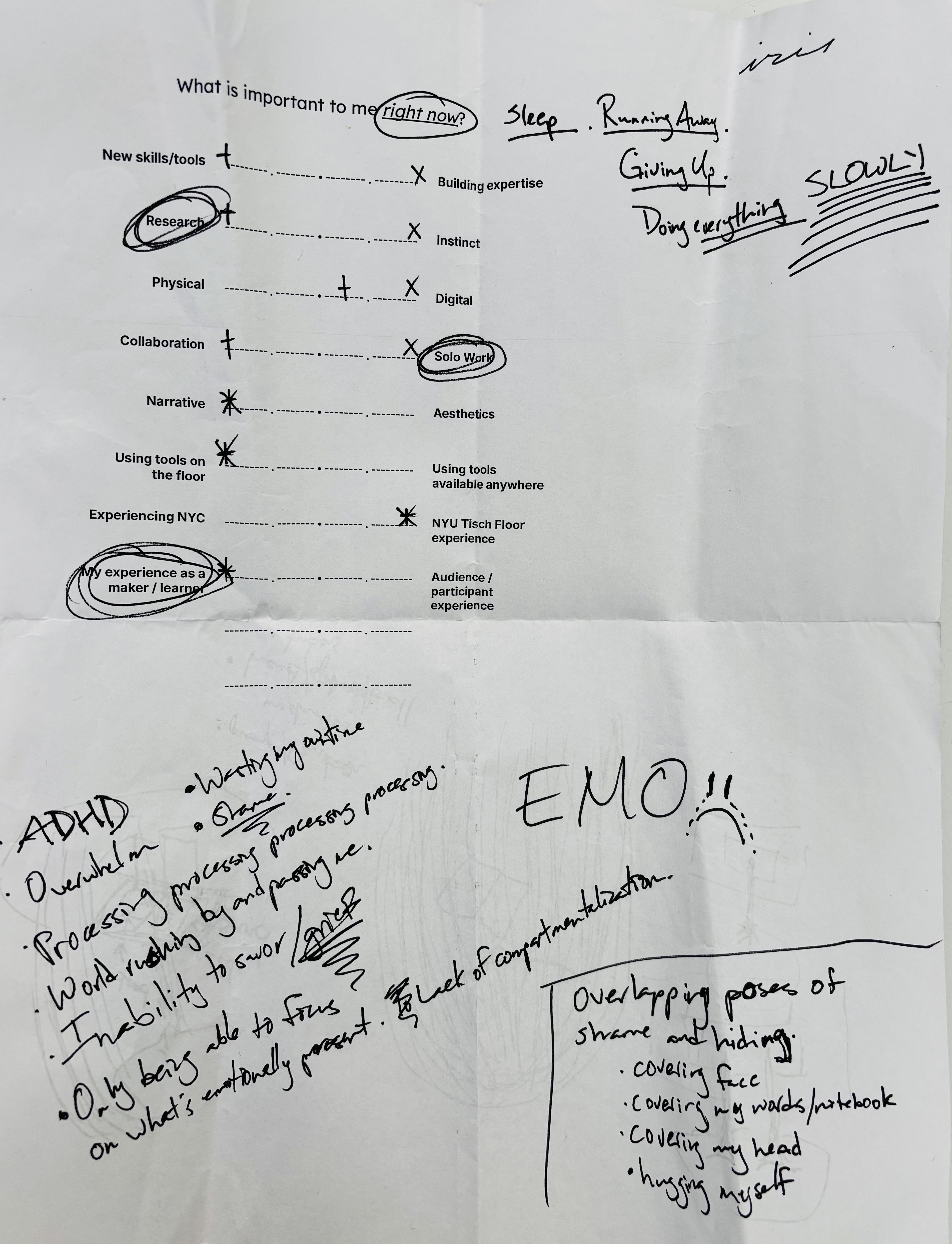
Last Monday, during Exploratory Making class, I was a mess. As we discussed priorities, it became clear to me that I carry tension from putting what I want from my art practice against what I think I need from it. The exercise didn't give me clarity on whether I should focus on new skills or building expertise as much as it helped me get in touch with my tears: my shame, overwhelm, grief. Next to "What is important to me right now?" I wrote, sincerely: "Sleep. Running Away. Giving Up. Doing everything SLOWLY"
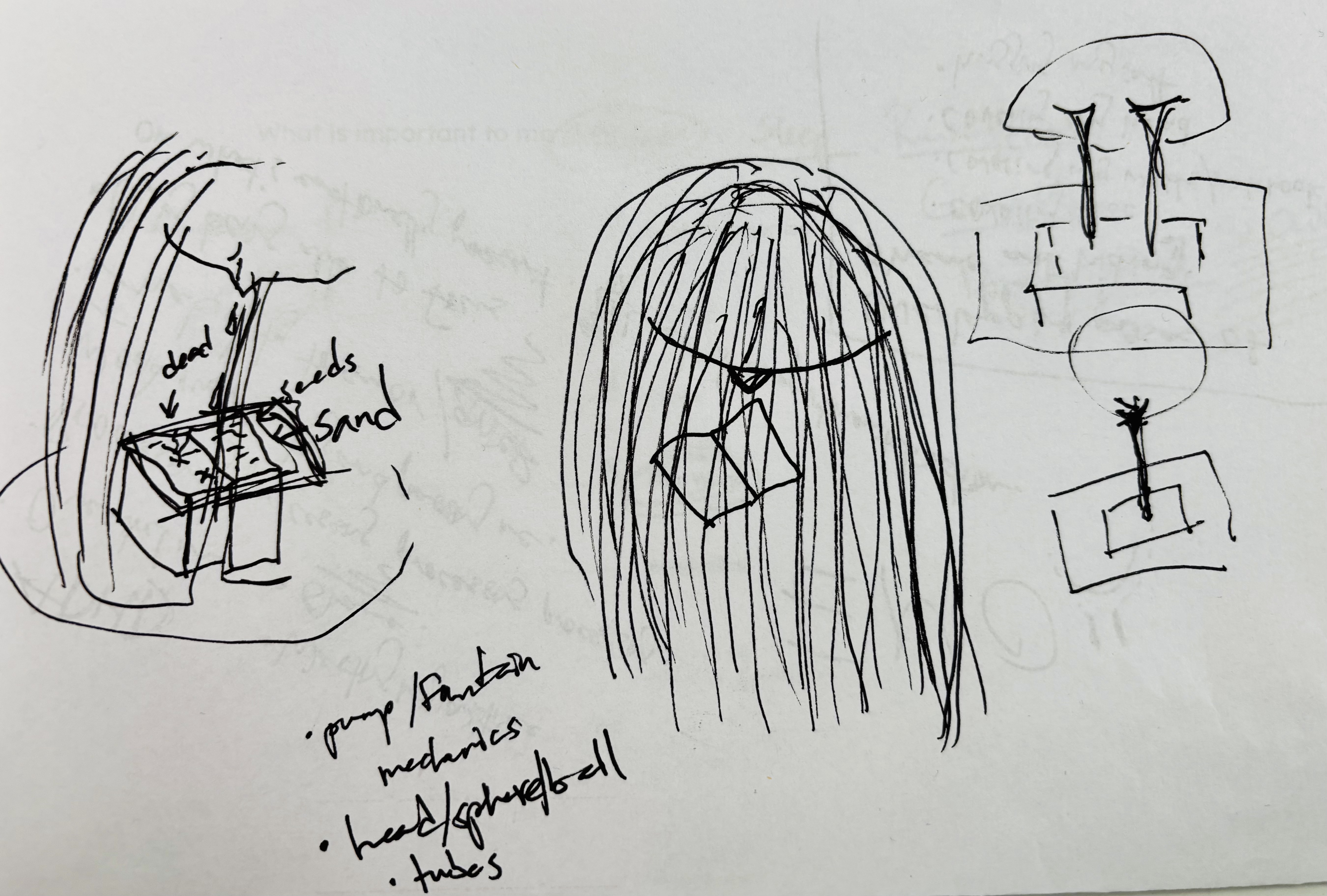
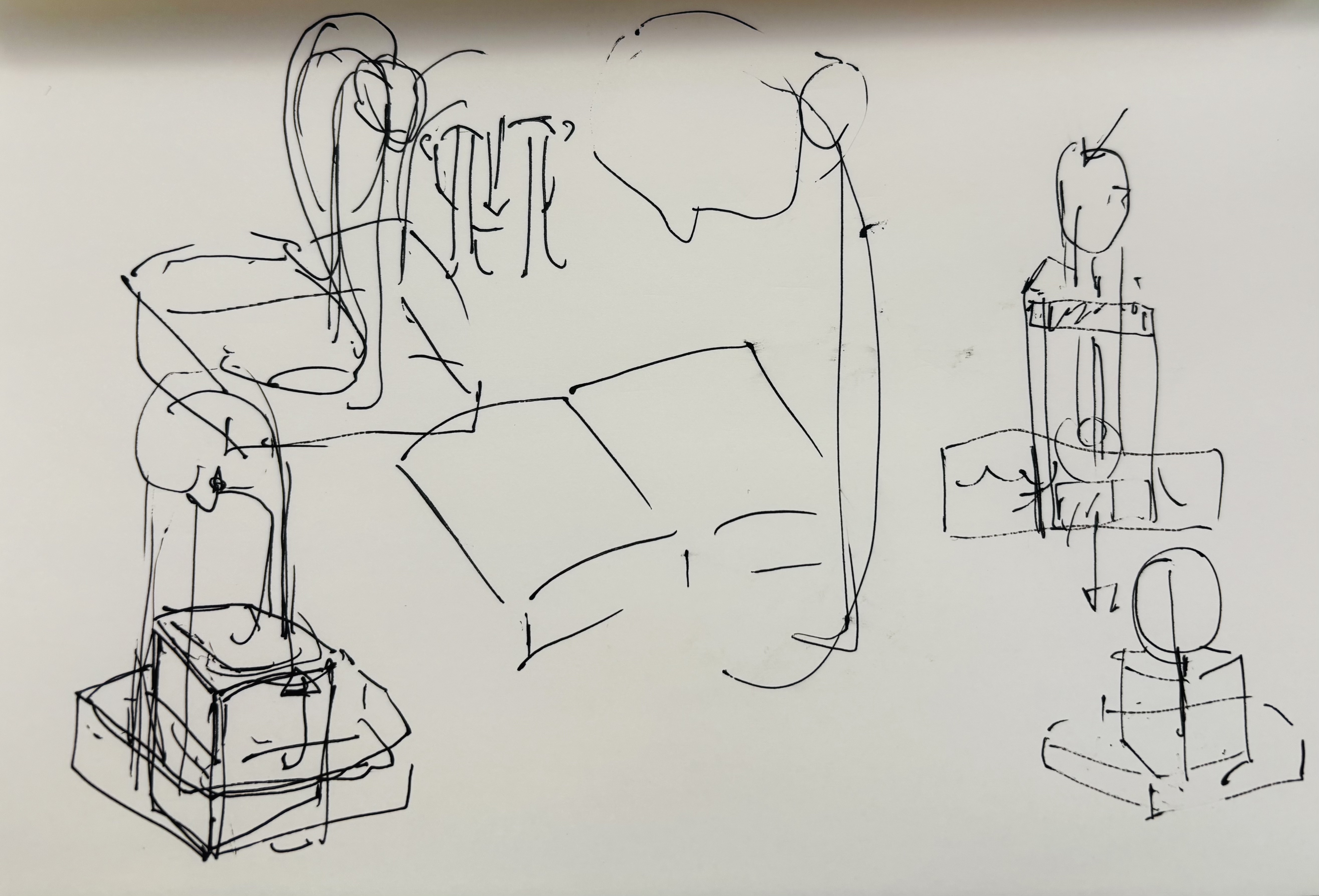
Getting in touch with strong emotions changed how I imagined the piece I wanted to bring into the world. I became attached (and I remain attached) to the idea of a curtain of water falling around arid soil. I knew the emotions I wanted to convey, and I knew I wanted to make a fountain. It was time to start making.
Starting to Make
After the priorities exercise, I sketched out some of my ideas with Brandon's help. I purchased a water pump, and I started to learn how to 3D print. I didn't like the models I found online for fountains or books, but I didn't know how to 3D model. Still, I needed to print out some tests. The first book I printed was tiny and it helped me get a better sense of scale, what to look for in online models, how to adjust models for printing, what different materials feel like, the importance of avoiding "Zoidberg" (the unreliable printer on the ITP floor), and how to navigate the 3DPrintOS software.
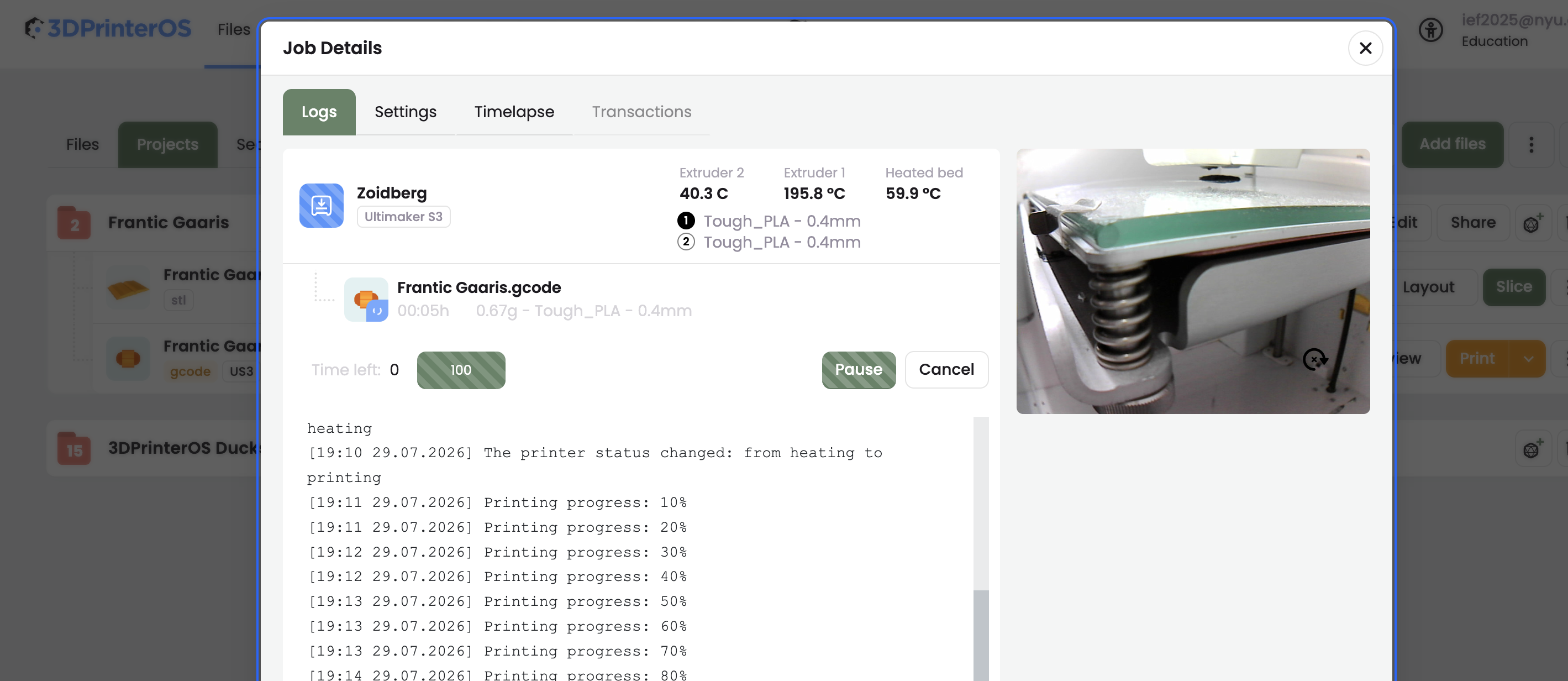
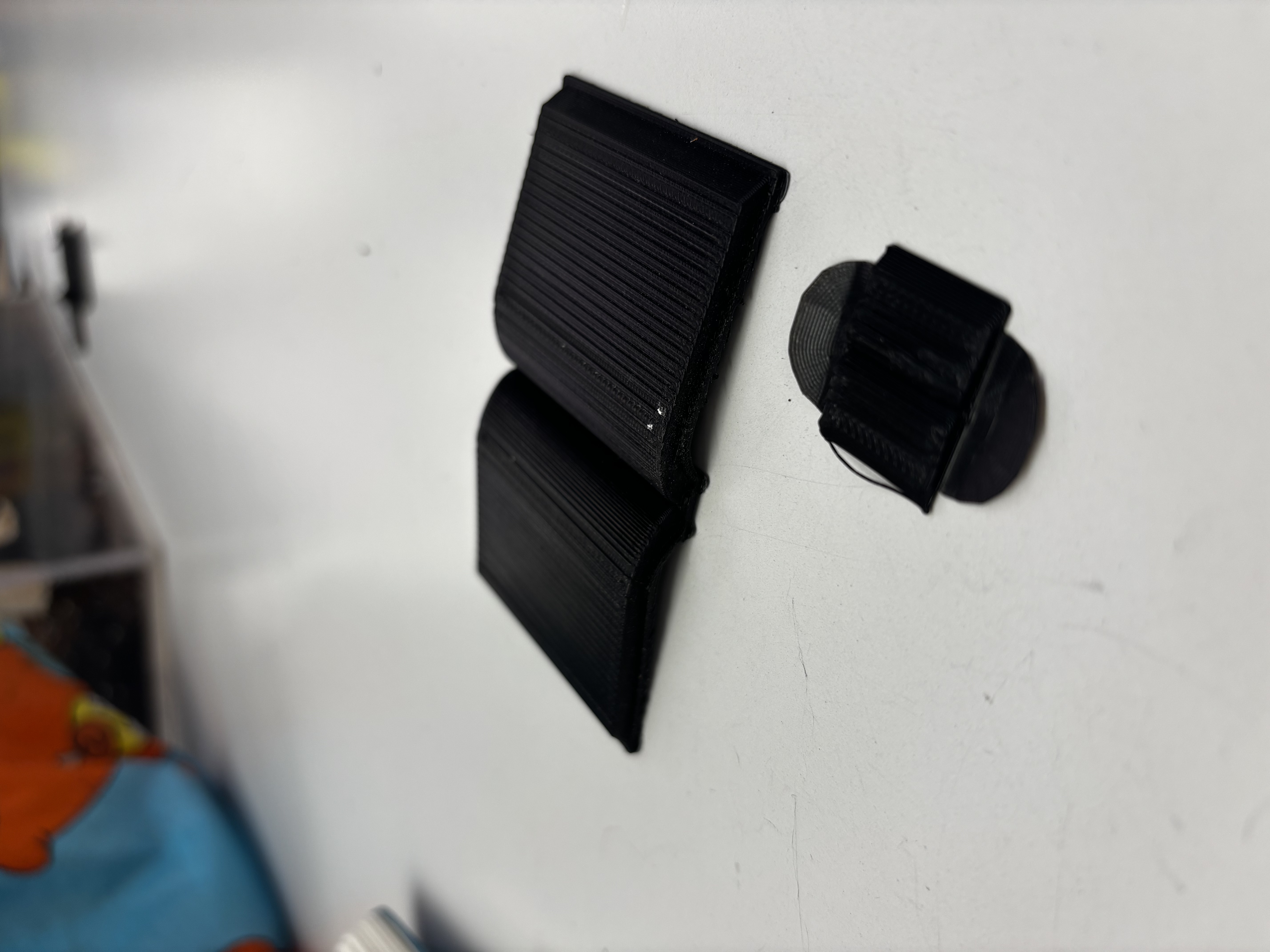
This initial experiment was a little disheartening, but I was excited to play with the water pump. I spoke to shop staff about my idea to build a fountain, and they recommended I start protoyping with cardboard first, which felt obvious once pointed out.
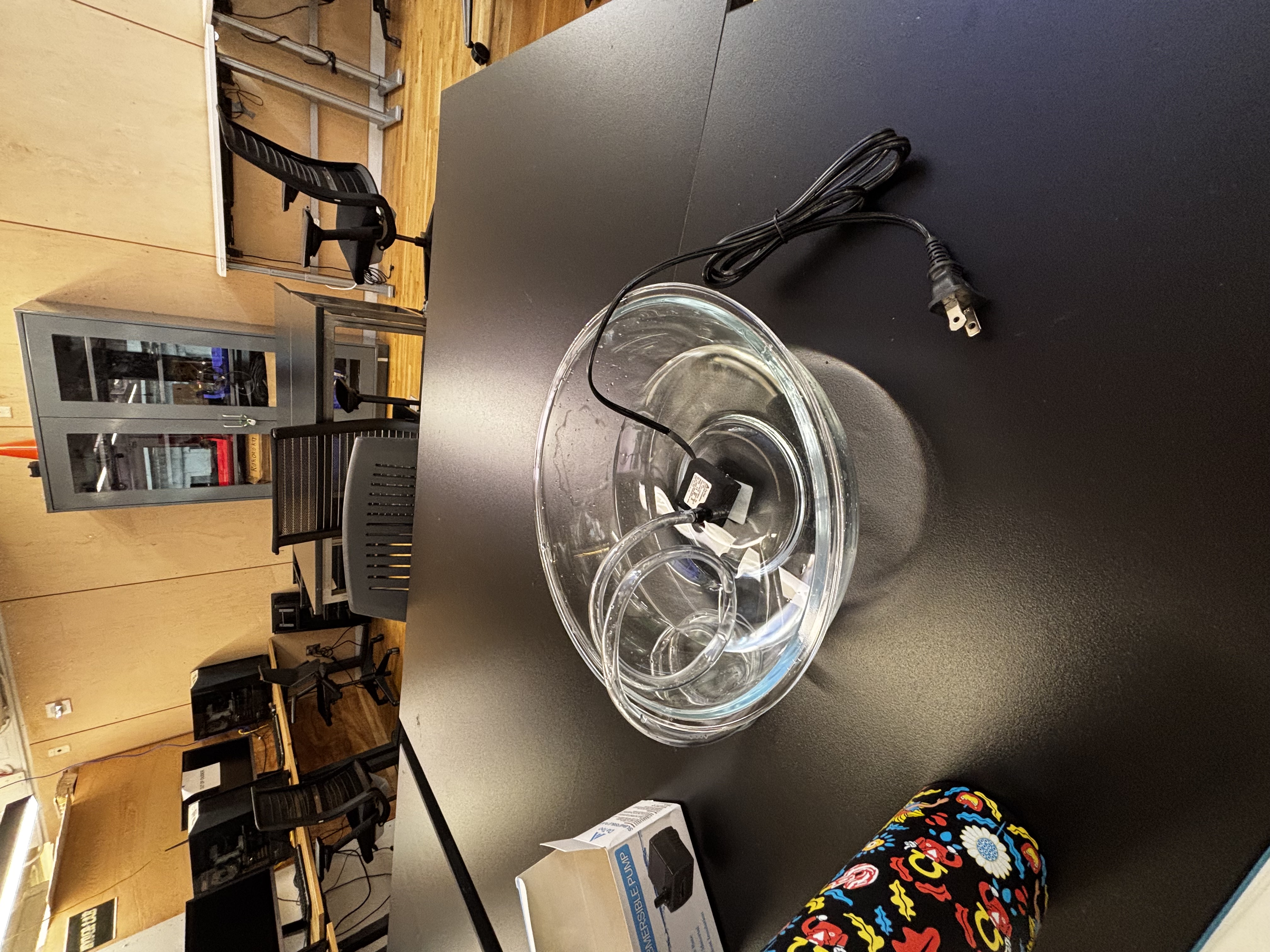
Experimenting with this project embolded me in another class, Interface Labs. I started to explore a fresh idea for a tactile music sequencer, and the 3D printing experiments equiped me to prototype it quickly. Working on IL felt invigorating and fun in a way I hadn't felt for weeks in the rest of the program. I got excited to protoype with cardboard, I started to learn and use Fusion 360 for modeling technical parts, and I learned how to use the laser cutter.
The sense of play I tapped into through Interface Labs made me think that maybe I'm not meant to mix concept and making. That maybe I should make without making sense, and I should make sense without making. Life is never black and white, but at least I felt confident again and I was once again enjoying myself through schoolwork.
Re-visiting the idea
At the same time, I was working with Riley and Carol on the Deep Dive for Concepts, Culture and Communication. The week's topic was Ecologies and Materiality, and researching complex systems of supply chains and pollution made me start to doubt my choice of 3D printing for the Exploratory Making project. Sarah had also recently asked me "why 3D printing?"
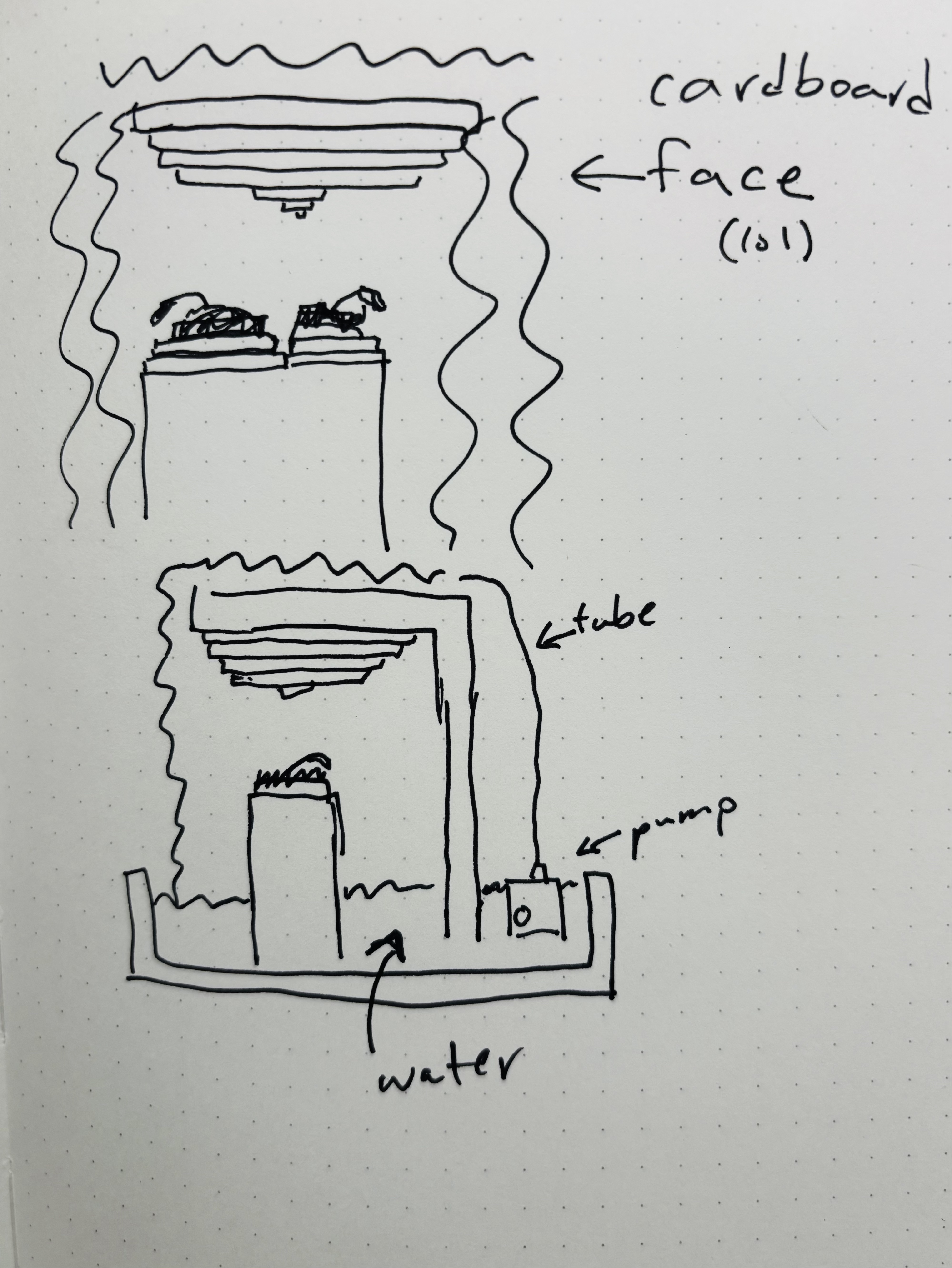
What if I just made a fountain out of cardboard and let it fall apart? After all, if I succesfully completed an artwork about artist's block, it would feel ironic and pretentious in a bad way. I like the aesthetic of layers materials, so while I decided against the cardboard route, I thought of moving forward with acrylic since I had newfound experience using the laser cutter.
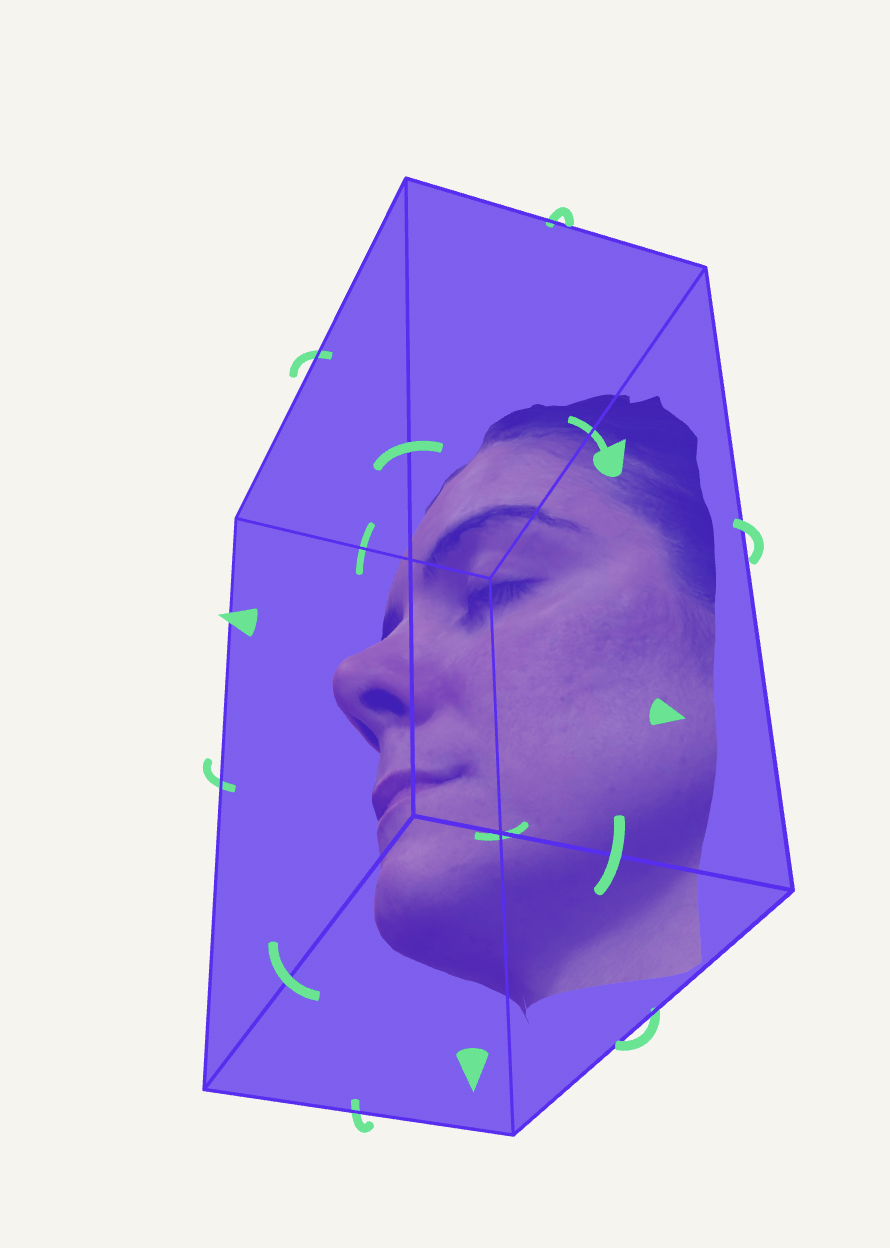
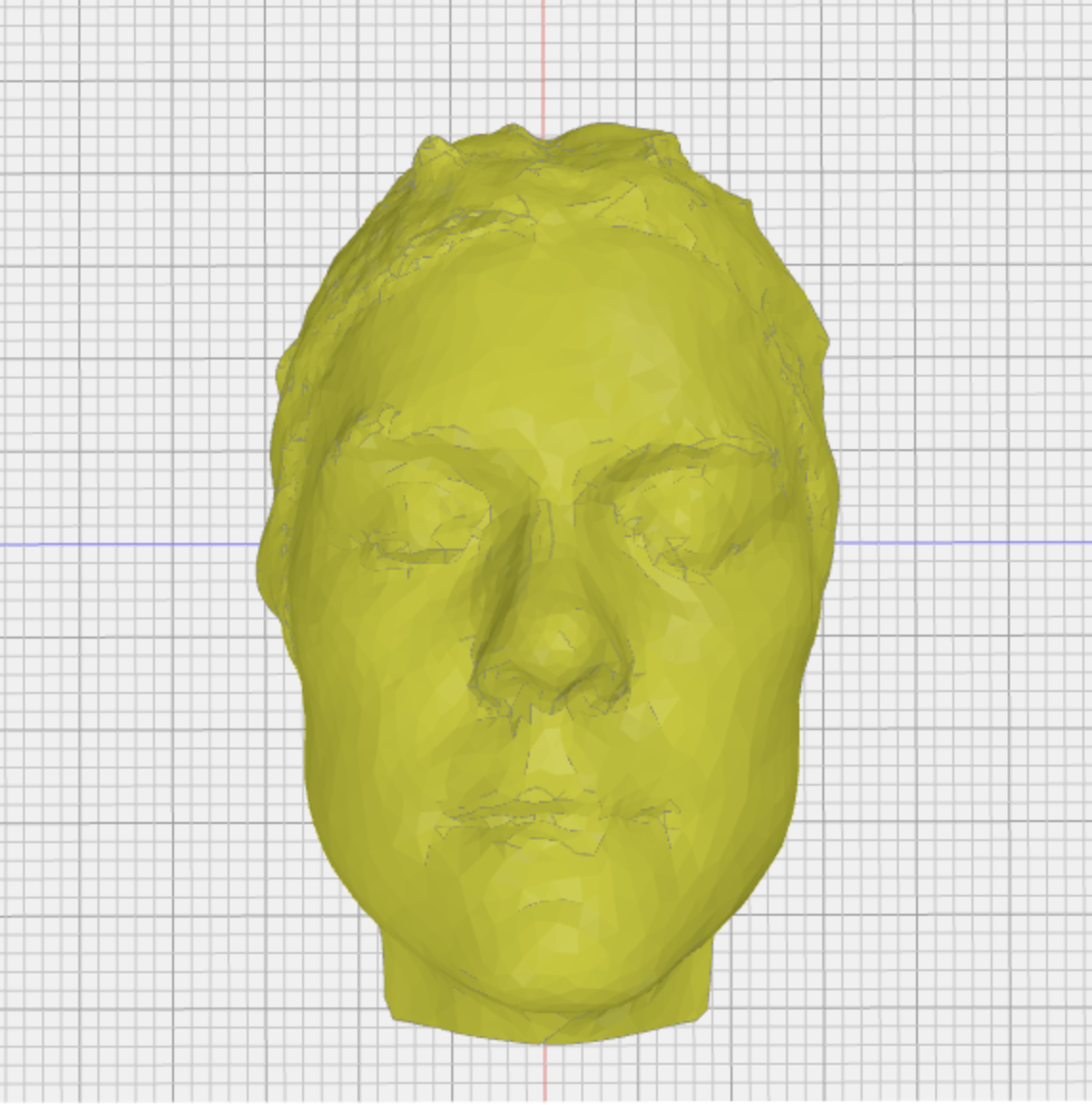
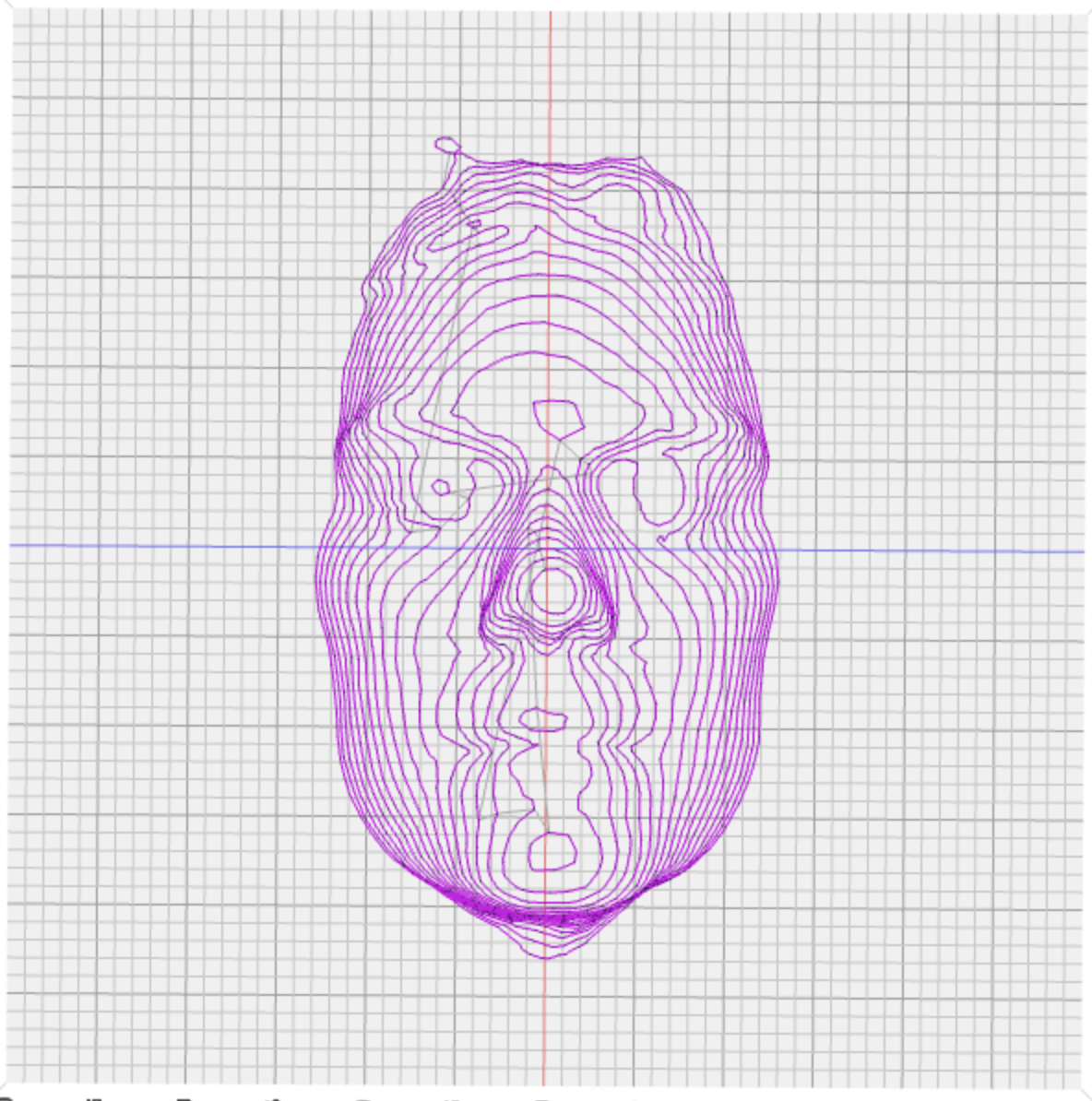
Friday night, my partner Mengna helped me scan my face, and Ian had told me about Kiri:Moto, a website that helped turn 3D models into SVG layers for laser cutting. But once I saw the layers, I didn't like the preview results. Plus I didn't have a ton of material to prototype with. I was bummed. I didn't want to 3D print my face, the laser cutting wouldn't work, and I don't know how to sculpt. Back to square one.
The head/face were a big part of the idea from its inception. What was I going to do without it?! I changed the focus to my hands, which I imagined in some of my first ideas, as the failed conduit meant to connect mind and work. Plus, my self-portrait for Creative Coding before the program officially started was a hand, so in some ways the hands worked better as an expression of Self.
Hand Casting
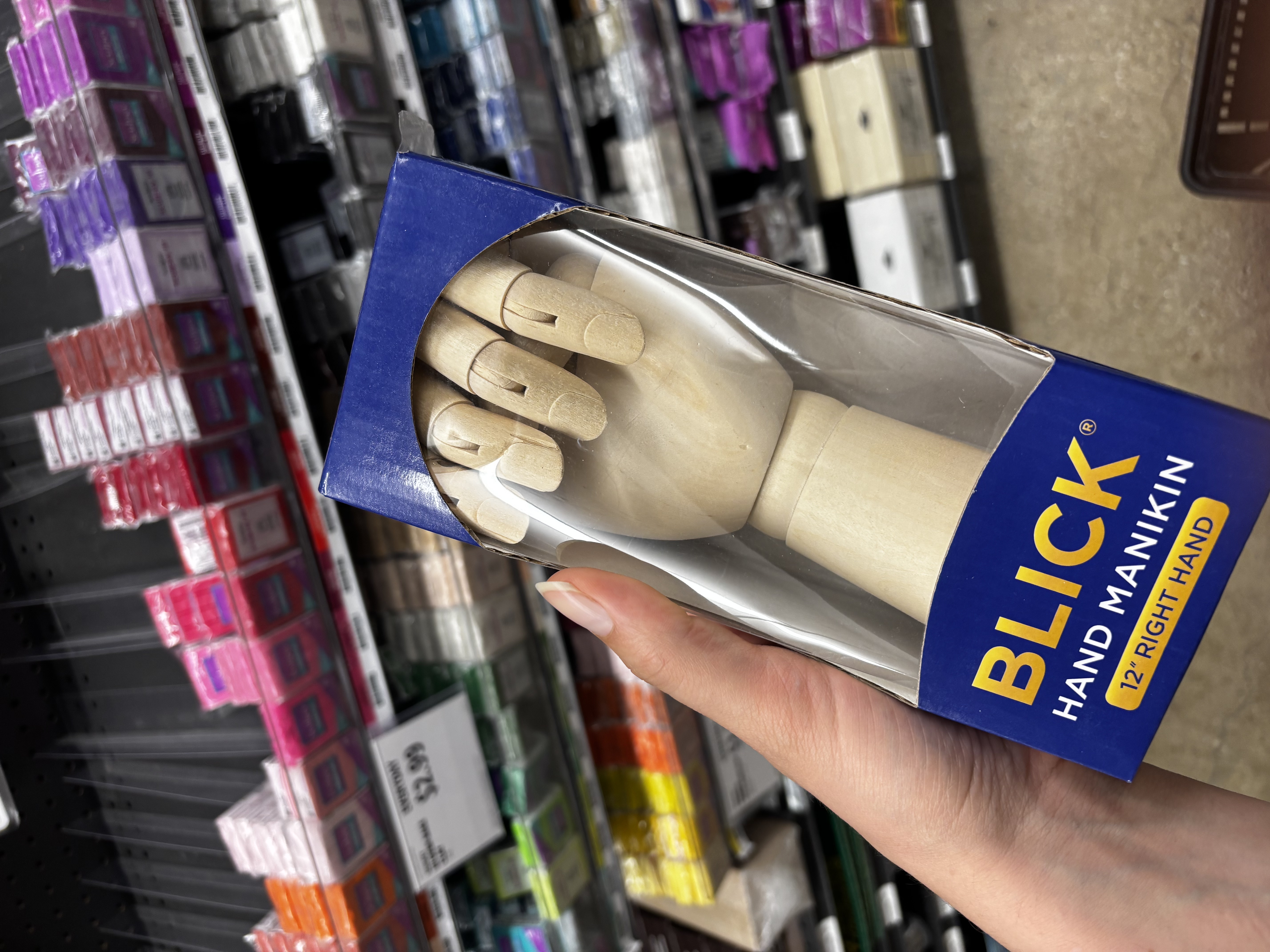
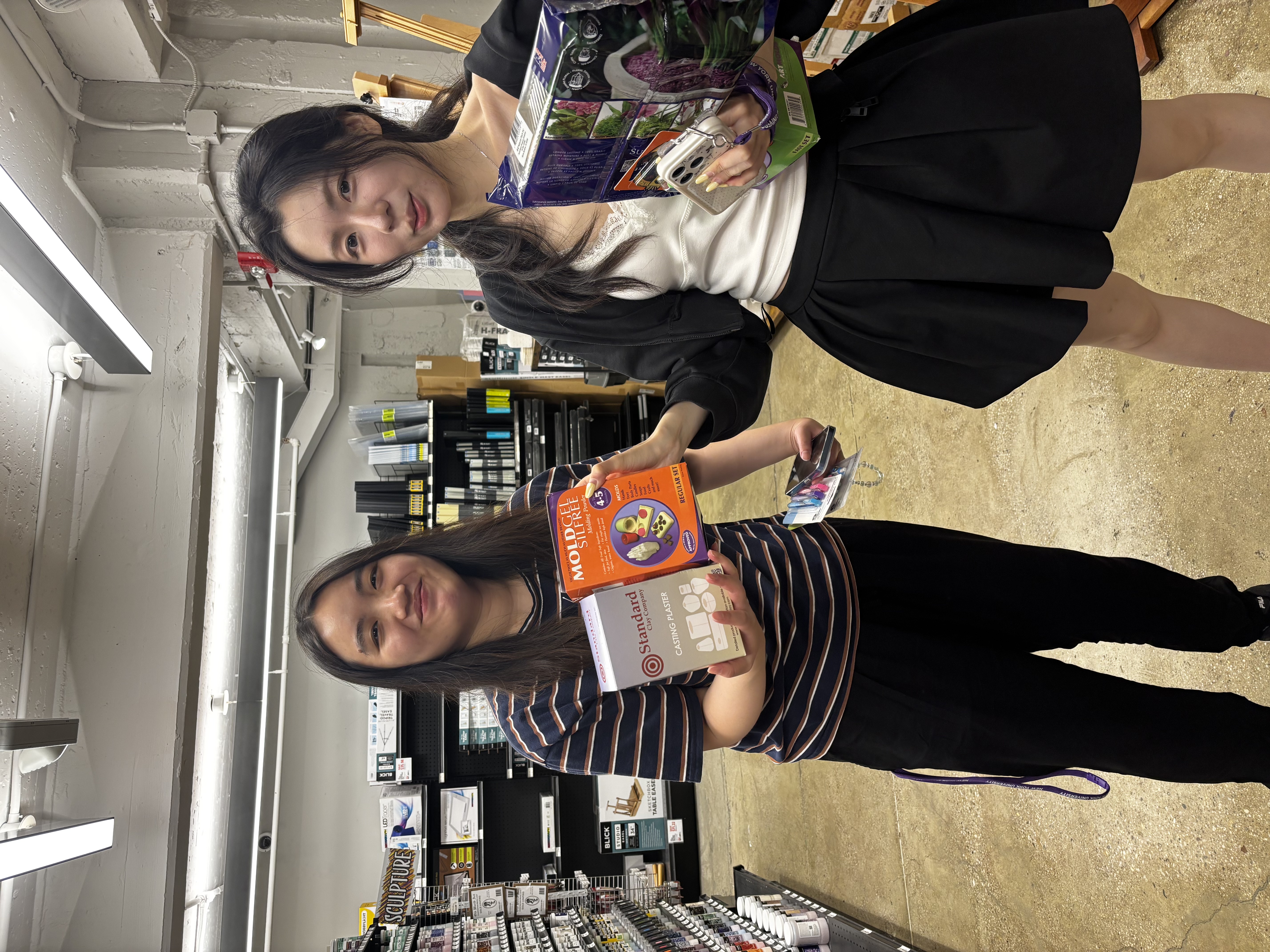
On Saturday, Carol helped me brainstorm ways to incorporate hands into my would be fountain. She gave me the idea to find mannequin hands at Blick. Once there, they didn't feel right – too bottom heavy. Tiffany and Yien convinced me to give life casting a try. So I purchased molding and plaster and got to work.
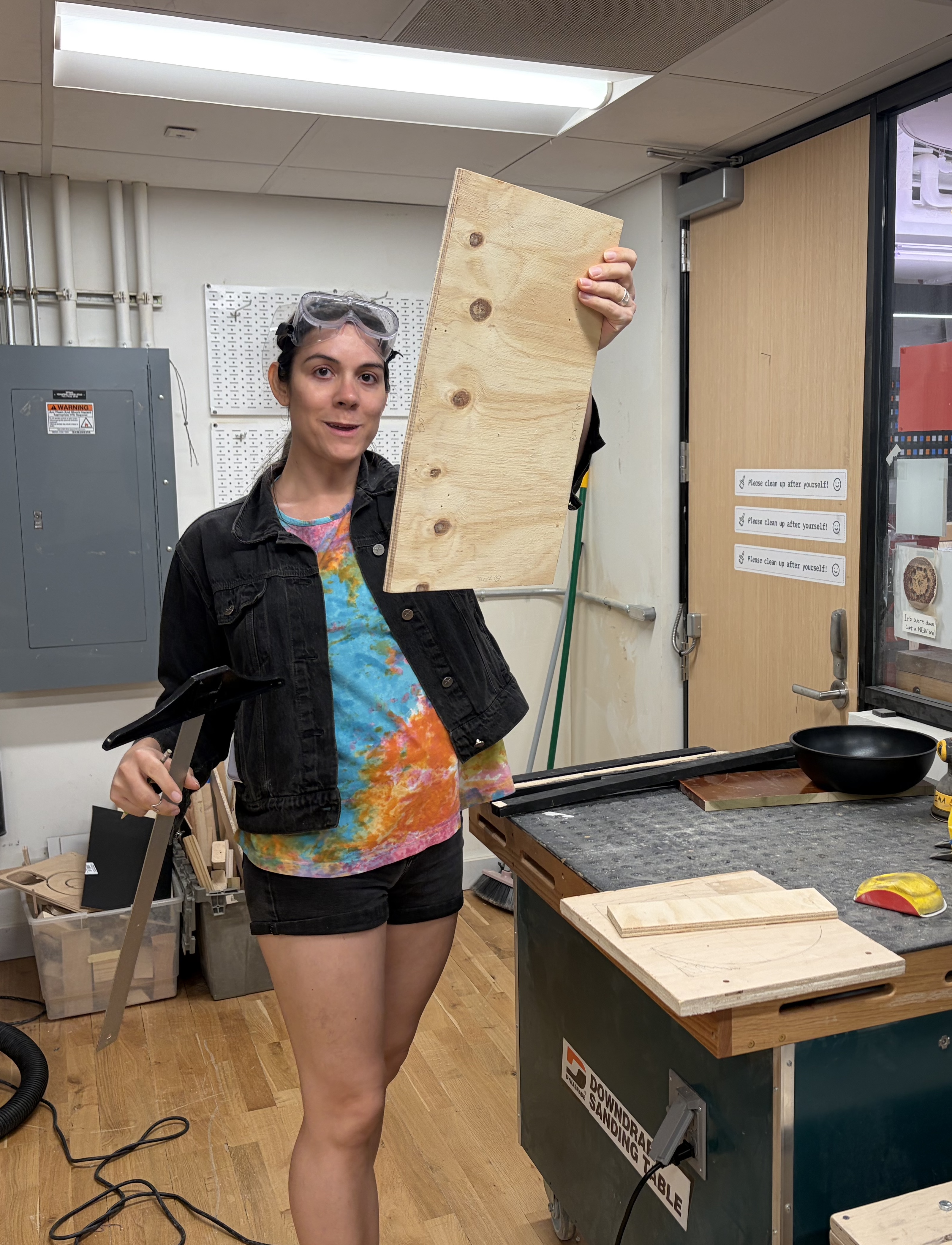
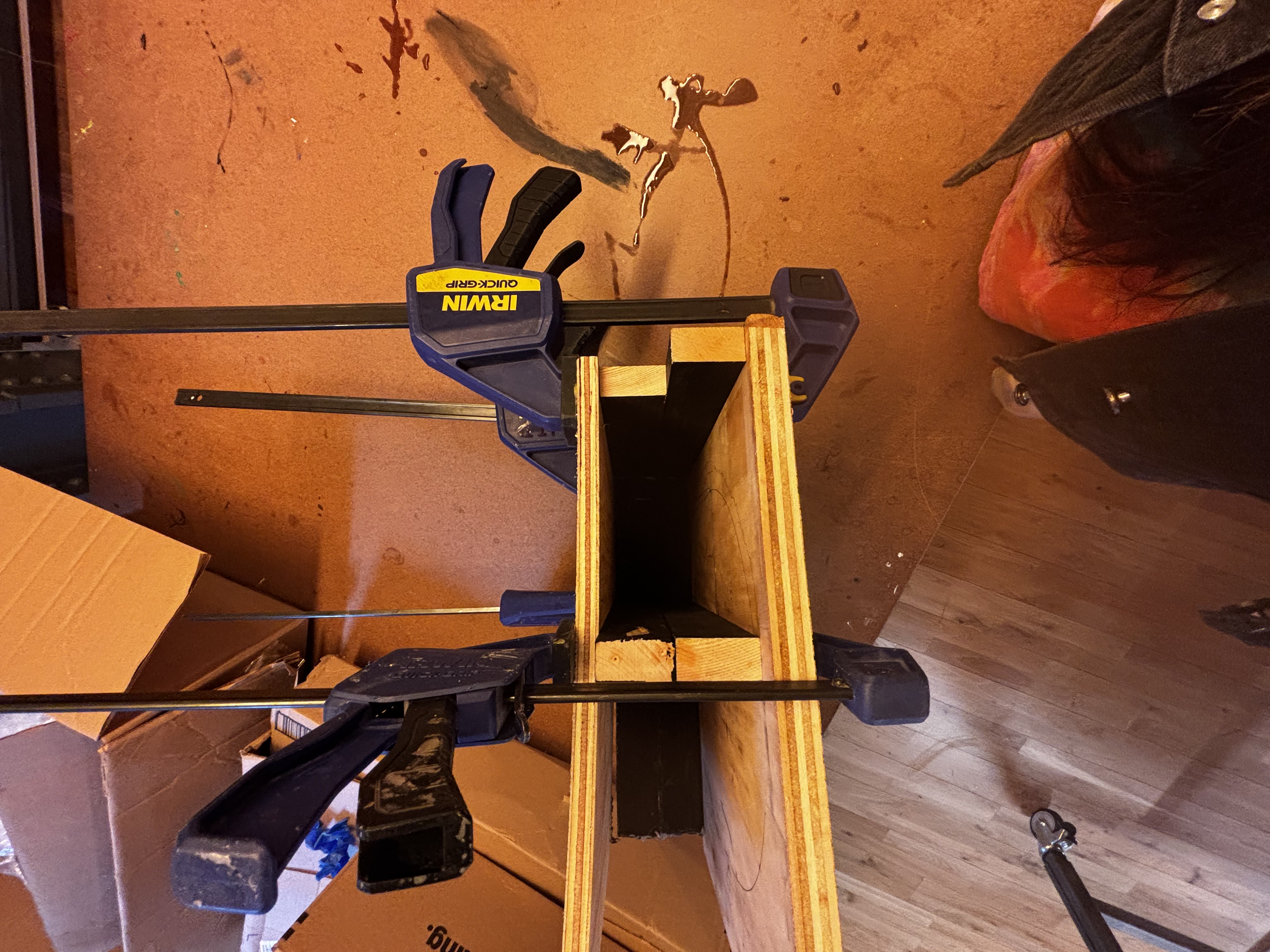
I needed a whisk and a bucket, but I didn't want to buy either, so I decided to make them in the wood shop. So for my first time using the wood shop I built a molding rig. I got scared when I realized the rig was too large for the amount of molding material I had bought, but James G reminded me I could re-make the rig smaller and just do one hand. Then, after measuring everything out, the plastic lining ripped right as Emily was helping me to do the mold.
Tiffany suggested instead I use the plastic container for the gallon of distilled water needed for the molding. Genius!
While extremely stresful to setup, the molding step was a success. Then it was time to pour the plaster, but I misread the instructions mixed way too much water than was needed. Emily helped calm me down, suggested I simply drain the mold, mix plaster again, pour it and hope for the best.
After cleaning everything up there was nothing to do but go to sleep and check in on the cast the next day. Regardless of what happened Sunday, I would use whatever came out of the casting process and design my fountain around that.
Fountain? What fountain?
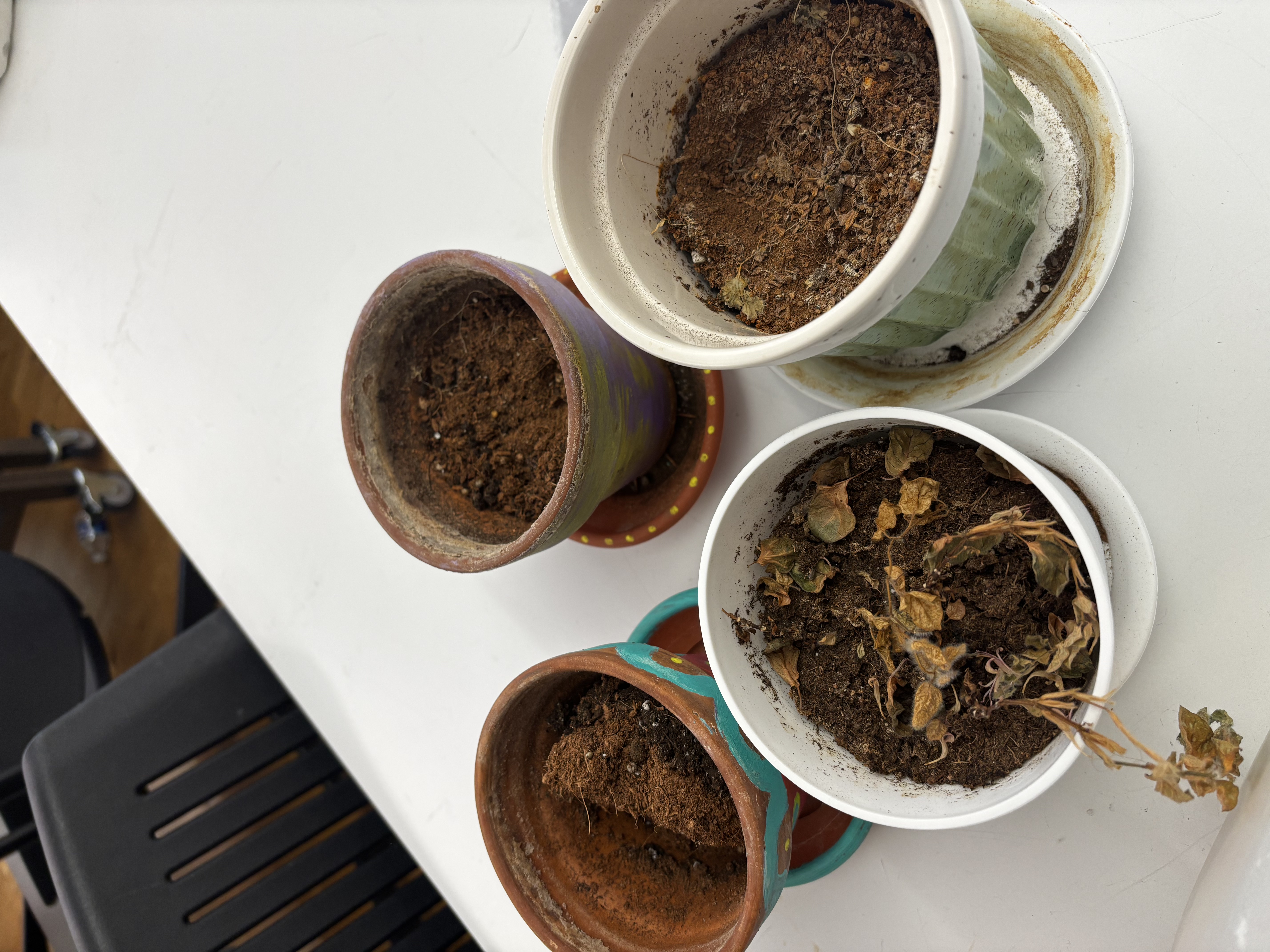
The next day, I gathered four small pots from home filled with dry dirt. Plants that all had died, life that I wish I could support. The idea is to put front and center the shame I have around my dreams that don't come to be.
[fountain sketches]
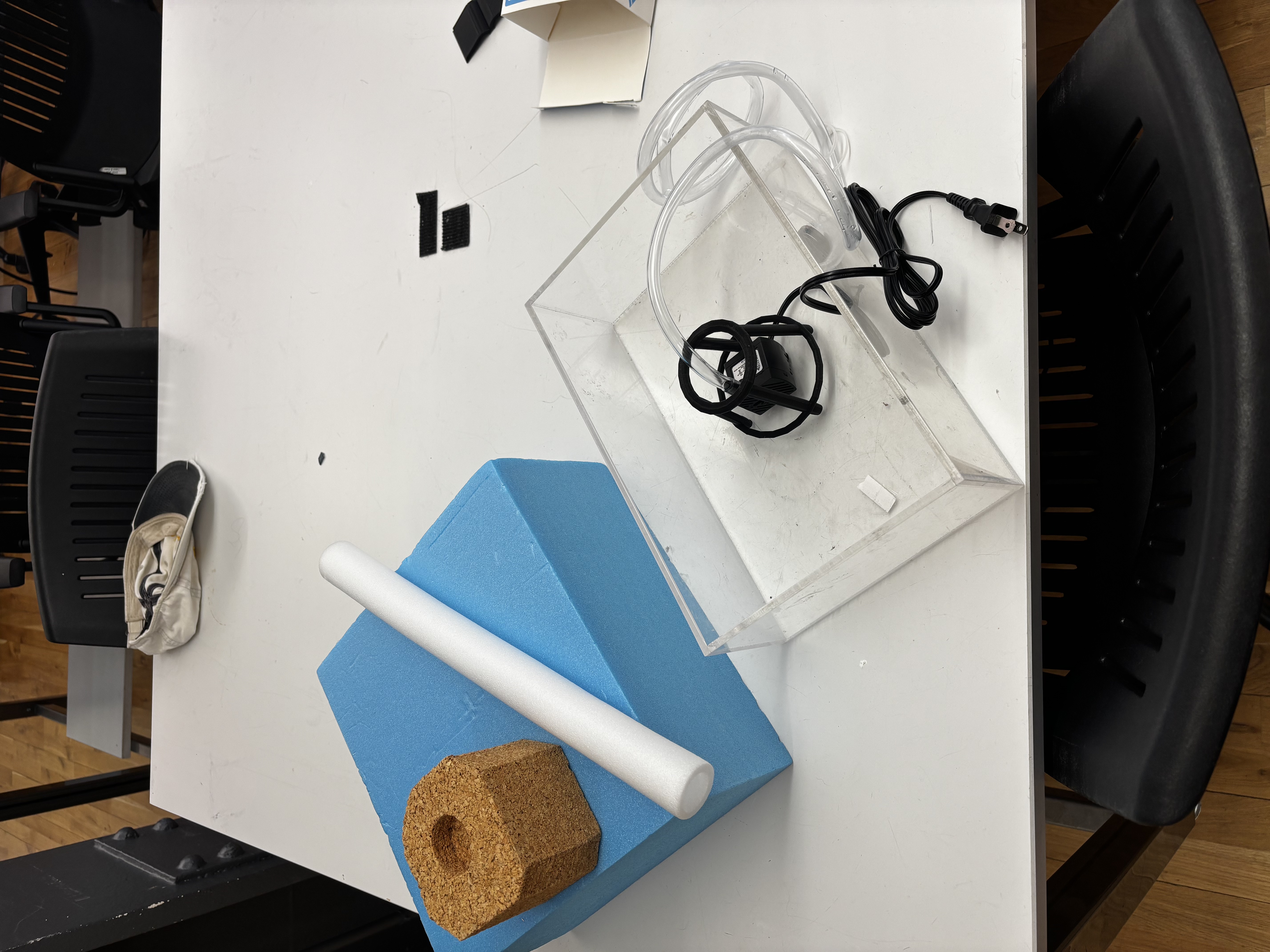
I got a ton of materials from the junk shelf and started to sketch ways to use them in the fountain. I was so busy trying to make a face or hands element work, that I never got to cardboard prototyping the main structure.
There weren't enough materials on the floor to build something large and waterproof. The casting experiments from the day before illuminated that working with water is much harder than I wanted it to be. My idea required more engineering than I assumed. I wasn't going to have enough time.
The hand reveiled
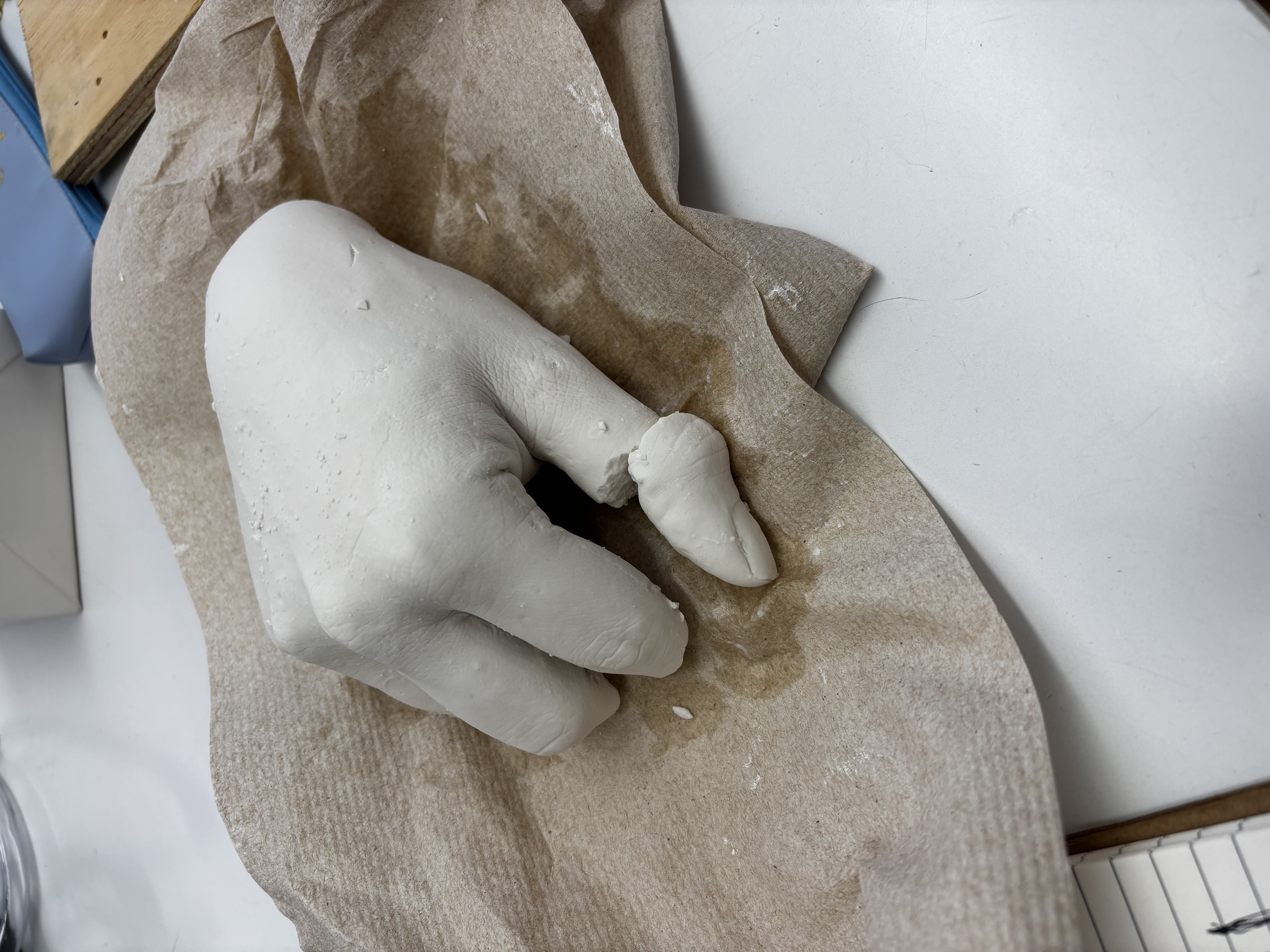
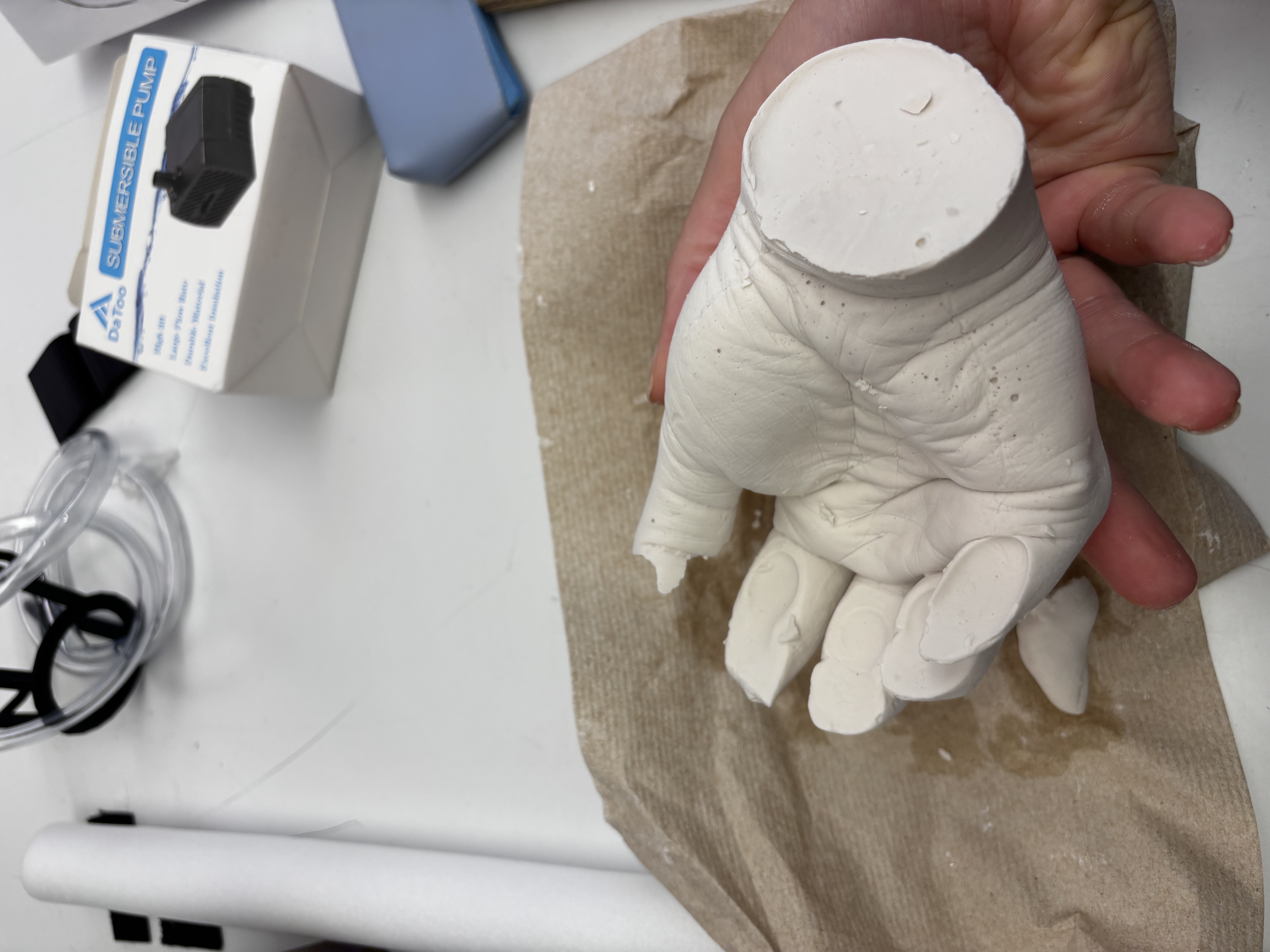
In some ways, the casting went better than I could have hoped for. The texture of the palm was superb. In other ways, it failed. For whatever reason I was really looking forward to fingers (even if severed), but it looks like air got trapped and the plaster never reached.
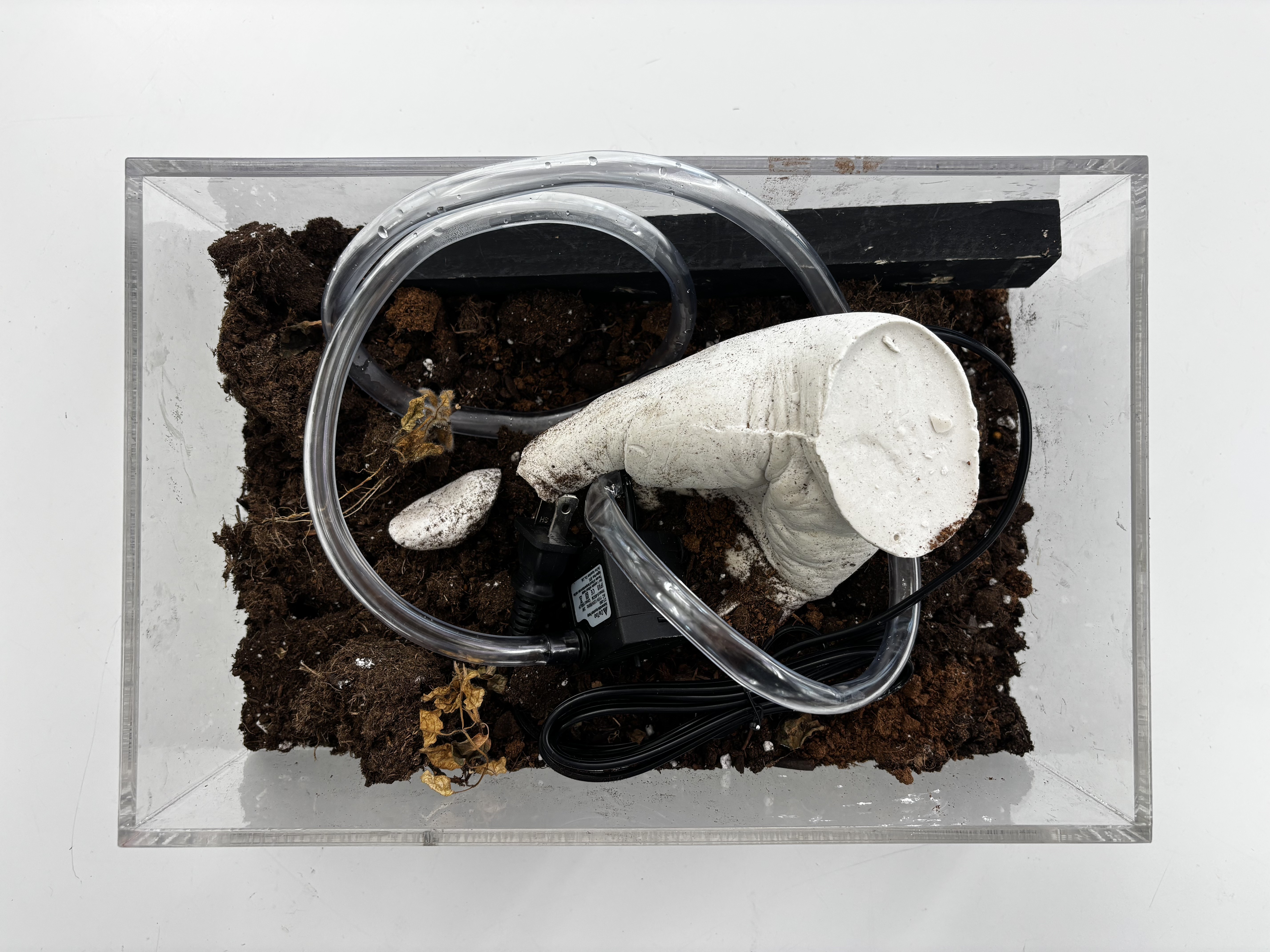
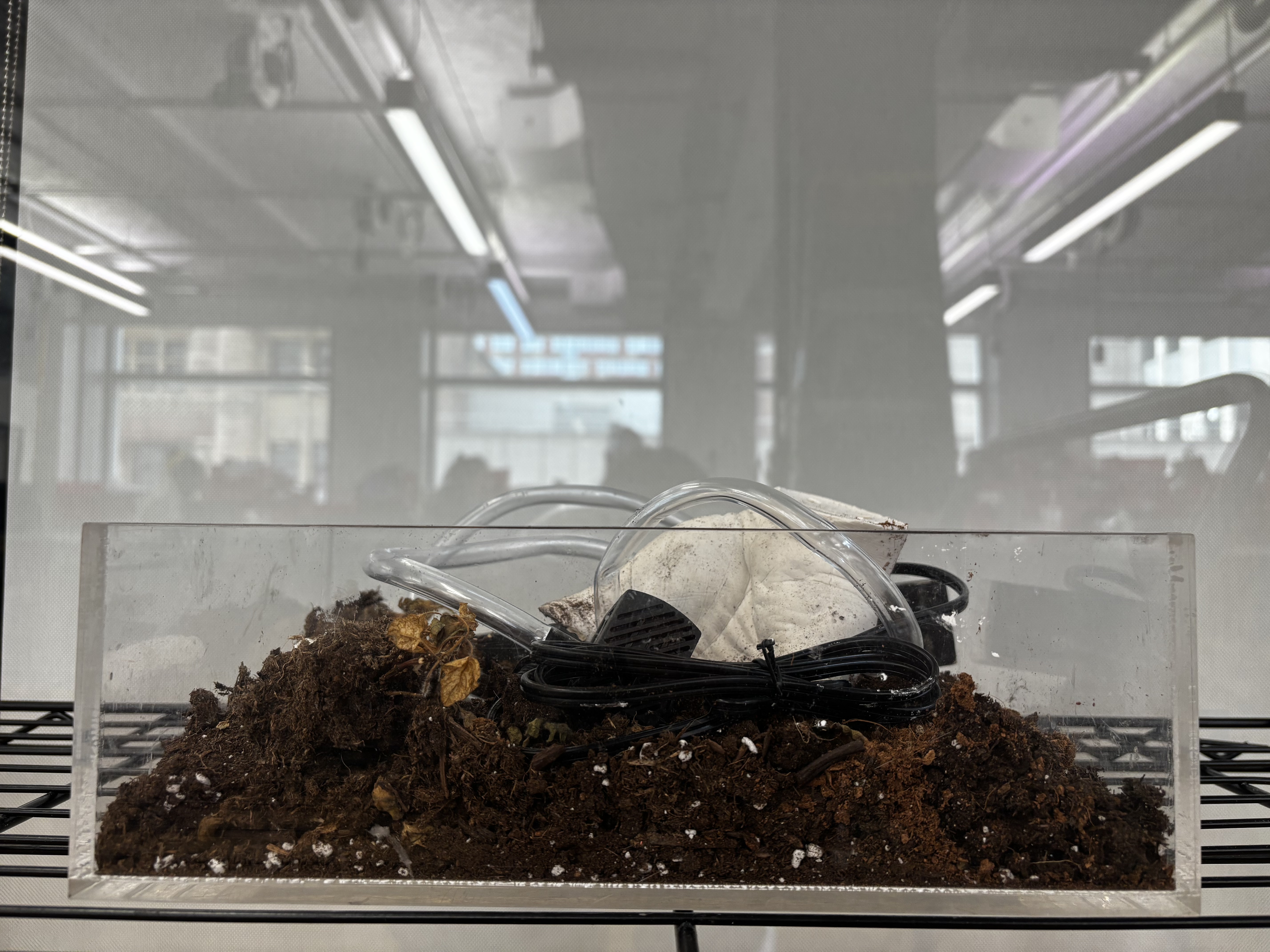
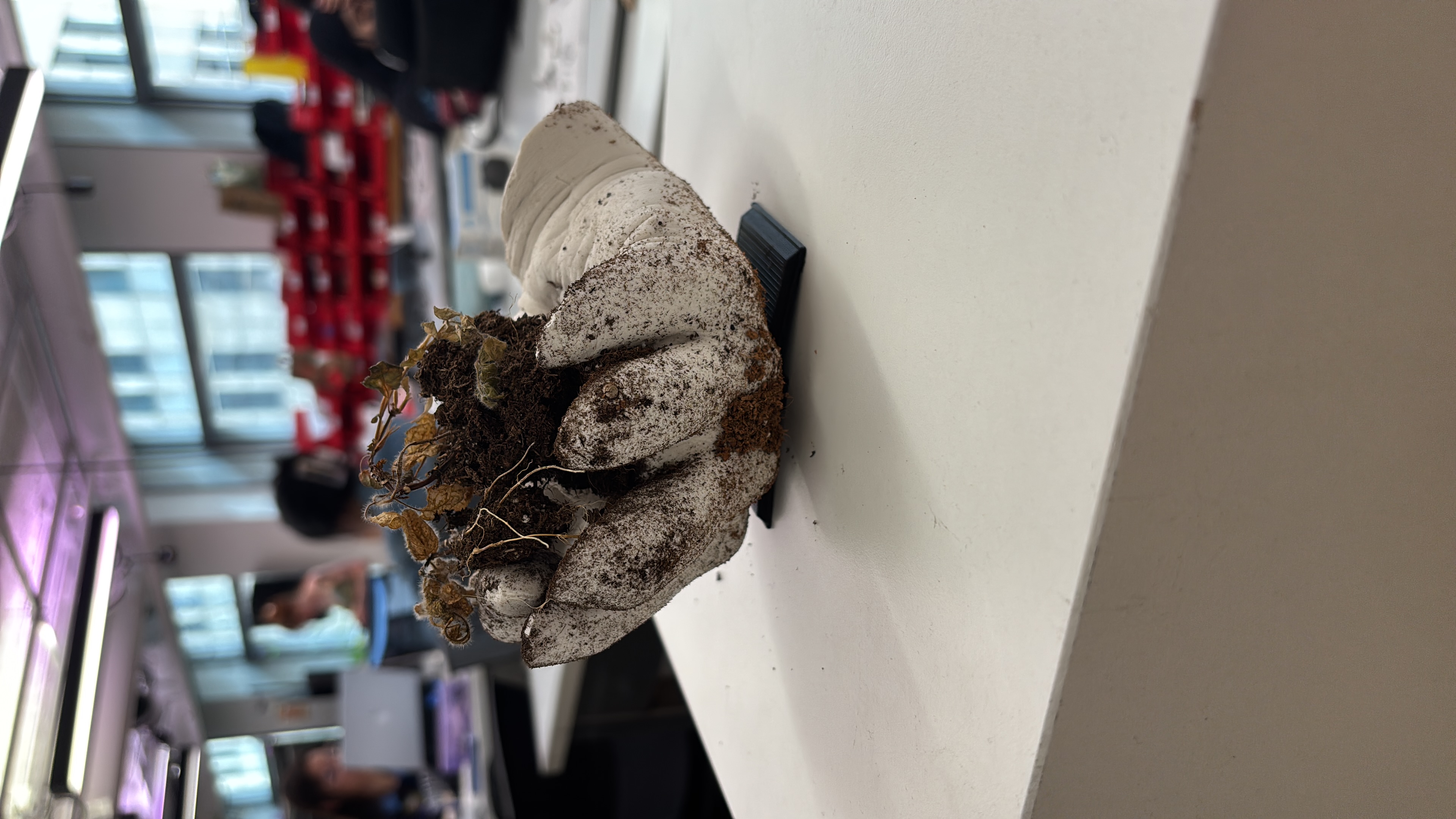
I decided to just use the hand cast and dirt. I tried placing them in an acrylic container, which resulted in some photos that I really like. "Pieces" was coming to me as a title. But I didn't like what it looked like in person. Then I read part of Rick Rubin's "The Creative Act" where he recommends a "ruthless edit" to strip the piece to it's most barebone elements: a partial cast, arid soil, dead plant, and plastic book. I placed the hand and dirt over the book to capture how large my feelings feel compared to my ability to capture (or document) them. I also like how the 3D printed book is a part of the work that I had completely moved on from but somehow made it back to the final version.
Reflection
I'm used to trying to cover shame with believing myself incompetent, and instead end making myself incompetent by basking in shame. So this work is an exercise in facing what's hard and choosing to move forward regardless.
This project ended up being about getting my hands dirty with what I'm ashamed of and scared of. It's about my hands feeling incapable of breathing life, how they feel broken for it, and how I'm trying to choose to see them in a new light.
In the process of putting together something, anything, I put together a slightly new version of myself. Putting myself together requires an intermediate state where I witness myself in parts. Looking at myself in fragments, I'm afraid to be broken, and I freeze.
I realize now that making as art is not like giving birth to a new being, whole. Art through making is an act of creation through assembly. Some artists work by starting from a place of deconstruction – assembling from the dissassembled – connecting from the disconnected. But I more readily arrive at art through yet-to-be-assembled, yet-to-be-connected, yet-to-constructed truths.
I cannot make sense of something first and then make it. I must make something first (and I must make it with the help of brilliant and kind-hearted minds around me) and make sense of the work afterwards.
As I make, I will fail. Now I want to remember that the feelings of being broken that follow failure are signs of the fragments that I am actually meant to put together.
What would I do with more time?
I'd make it a fountain! I like the look on the pedestal, so I'd try to construct a waterproof base to catch the water near the floor and mount the pedestal on plastic feet. The pump itself would probably hide under the pedestal. I'd fabricate a white "wall" behind the pedestal to hide the tubing, and above the pedestal would be a "ceiling" pool that would pour the water around the current piece. I'd need to acquire some proper materials at a hardware store.
Special Thanks
To Emily, Tiffany, Yien, Carol, Brandon, James G., Sarah, Mengna, and the Shop Staff!